Wednesday, 16 November 2011

Asian and European educators meet in Dundalk, Ireland


Back from the 10th AEC-NET (Asia-Europe Classroom Net) conference, my mind is buzzing with ideas. After many years of coordinating AEC-NET projects, and preparing project presentations for the conference, this time round I took the backseat, to be able to observe and reflect. The Singapore admin team, together with the Irish conference hosts, had put together a hectic 5 days of lectures, workshops, presentations, and project group meetings, under the title 'Apps in Asian and European Classrooms! Unleashing Educational Creativity'.

Schools in most participating countries have definitely moved on. There is serious talk about taking action, and not just marvelling at philosophical ideas somewhere in a distant 'cloud', as used to be the case a few years ago. Many schools are technologically quite well equipped - some have even moved into the 1:1 laptop or iPad era, like my own. The hardware is there but now the question is how best to utilize it to enhance learning, and engage our 21st-century students.
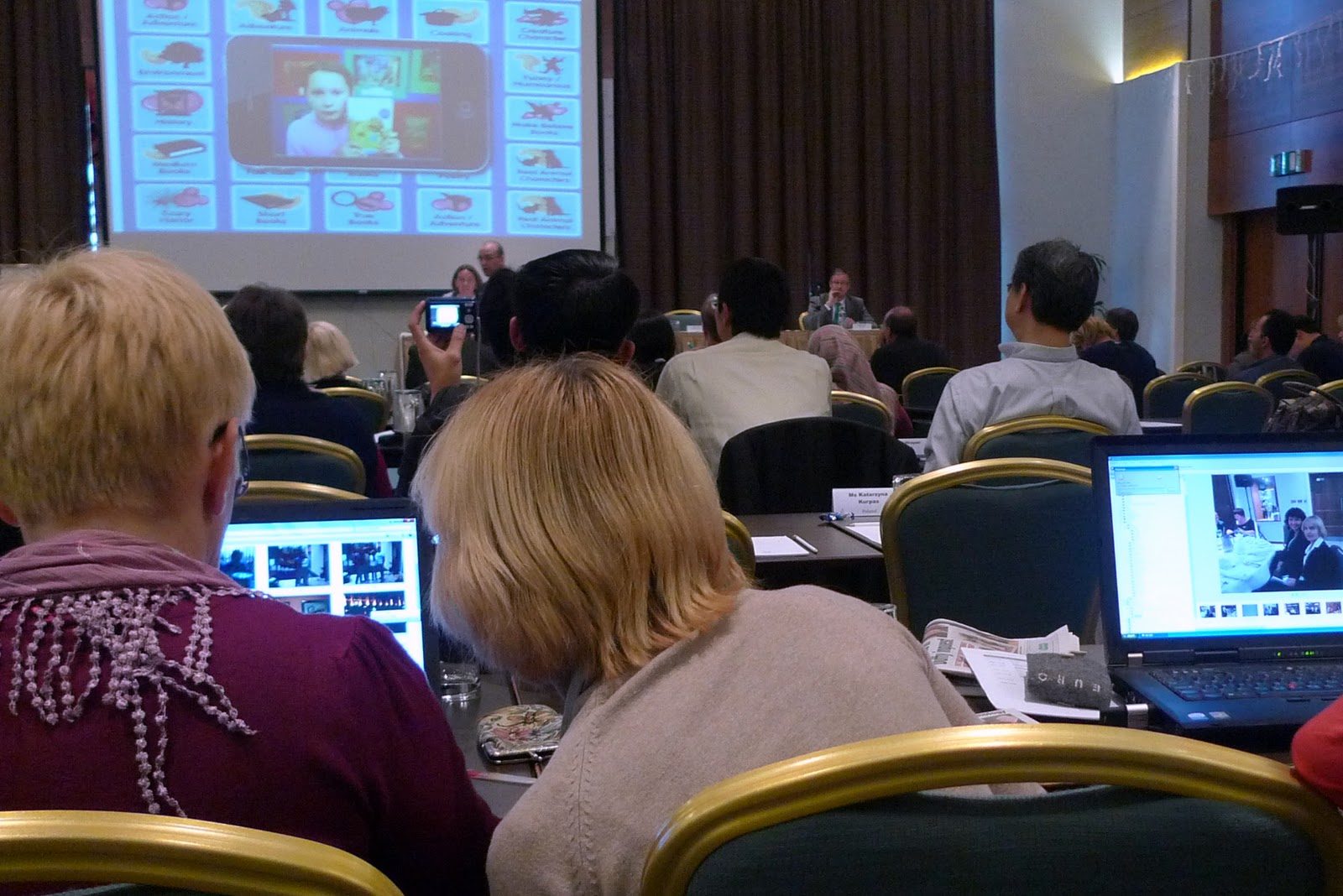
The conference scene has changed a lot, too - screens of different sizes abound amongst the audience

One afternoon we had a dynamic 5-workshop 'speed data' session, with app after app presented at a breath-taking tempo. Tagxedo word clouds, Animoto videos, Geogebra, Audacity, Google apps, Vimeo, Kinect Scratch, blogging services, Etherpad... An endless list of applications and gimmickry was blast onto us, like a firework show. I wonder what the more techonogically novice teachers thought, as even I, with at least some previous exposure and knowledge, found it challenging to follow! I started to think that while it is certainly useful for a teacher to have a digital "toolbox" of various apps, for example, to visualize complicated concepts, in the end, using hundreds and hundreds of these apps all the time is not the key issue. True, this session kept us teachers awake and running, in the after-lunch sleepy hours, and would probably work to do the same for students, but something more solid is needed to shift educational practices.

One of the most interesting presenters for me, was Ms Chan Lai Peng, Deputy Director from the MOE in Singapore. Having organised some student exchanges, and virtual projects with schools in Singapore, I have realized how much our two small nations have in common, despite the striking geographical and cultural differences. Both nations, with small populations, have competed for the top positions in the OECD PISA assessments, for example. Ms Chan explained to us how they have come to the 3rd Master Plan concerning ICT in education. Vigorous programmes have been put into place to deepen the pedagogy of ICT use, and for each school to reach a base line standard in ICT integration. A lot of attention is paid to cyber wellness programmes, with student ambassadors to tutor their peers in every school. What's more, every school has a full-time technical assistant on site - something that we Finnish teachers can only dream of! Ms Chan finished her lively talk in this observation: "Technology is but a tool but it can be a powerful one when put in the hands of skillful teachers." It is our challenge now, as teachers, to keep updating and developing our skills to keep up with the fast pace of change.

Monday, 10 October 2011

A guest blog post by Lindsey Wright: EFL Beyond Blogging

First ever guest post in my blog. Lindsey contacted me, and kindly offered to write about some other online activities for EFL classes, after reading about my blogging experiments. Thank you for these great tips and links!

Lindsey graduated with a degree in Public Health Administration before relocating with her family to Seattle. She is currently writing, and her favorite topics include health care, work-life balance, and travel.

Teachers everywhere are using the Internet, with its wide variety of instantly available information, as a helpful classroom tool. But did you know the Internet is useful for more than research? There are a wide variety of exercises for teachers of English as a foreign language that are available online. One of the most common exercises for teachers who incorporate interactive internet assignments into their curriculum is asking students to write a blog, but there are also other interesting activities out there for students to experience while enhancing their education. Here is a list of just a few engaging activities that you may want to explore with your students.


Webquests

One of the most useful tools on the Internet for teaching EFL students is the webquest. A webquest is a lesson plan that is based on proposing questions that students can research and easily answer on the Internet. These “quests” are perfect for students of all levels as well as students who are just learning English, and cover a wide variety of topics. This is largely due to the fact that webquests are designed to maximize the power of a lesson. They are set up so students spend a lot of time using the information they have found rather than looking for it, and use higher level thinking and build language skills as well.

Generally, students who have basic computer proficiency will be able to handle webquests, even if they are younger or are not very familiar with English. Webquest assignments may need to be adapted if the classroom only has one or very few computers, but can generally work in almost any situation.

Wikis

Another helpful tool for EFL teachers that is being used for online schooling and classroom exercises alike is a wiki. A wiki is a website that is created and edited collaboratively by multiple users. A class can select a topic of interest to them (whether cultural, historical or related to units in other academic classes) and build a website with information about the topic. Additionally, wikis help students learn on an individual level. Each student can be assigned a page that is specifically interesting them that still relates to the overall class topic, and will need to develop research, reading and writing skills in order to actually write their wiki page.

This is a fairly hands-on project for a teacher and requires a familiarity with the Internet and the creation of wikis, but it can be a really powerful tool for a class. Students will be really proud of what they've done when they see their work on the Internet, and the project will develop their language skills in a variety of areas.

Fake Facebook Pages for Historical or Fictional Characters

A final tool that may really engage EFL students is the creation of Facebook pages for historical or fictional characters. This is a really great way to develop research and writing skills while connecting your EFL lessons to other classes. You could assign historical characters from the period of history that your students are studying in their history or social studies classes, or you could assign fictional characters from novels or short stories that are being read in an English class. Alternately, you could simply choose characters that your class has expressed interest in and go from there. The creation of Facebook pages involves research in order to find out biographical information about the characters, as well as photos or artistic depictions of them. It can also develop writing skills as students have to write information about their characters on their pages.

Students will probably be really excited about this project when you announce it to them. You'll have to pay attention, though, as using social networking tools in the classroom makes it all too easy for students to goof off and check their own Facebook pages rather than working on research and writing for the assignment. Also, some school systems may block the use of Facebook on classroom computers, but a variety of offline templates for this project exist. If you can make it work, this will be a great project for your EFL students.

Clearly there a number of ways that allow you to make learning English exciting to your students. However, what is better still is that your options aren't limited to the lesson plans mentioned here. The Internet has opened up a whole world of educational opportunities for teachers and students alike, now all you have to do is explore!

Tuesday, 13 September 2011

Blogging with students 4

One of the most useful aspects of blogging with EFL students is the interaction created through commenting. From previous experience in global collaborative projects, I know how hard it is for many students to get the hang of quality comments. Without careful guidance, they mostly use the colloquial, short social network-style (Facebook etc.) comments, such as 'wow', 'great job' or other similar exclamations, followed by a long line of smilies. To get a little bit more formal and deeper with comments, we discussed this in detail in class, and I also published specific guidelines in the class wiki, modified from the ones I used to use in international projects.


It seemed to work quite well for the first blog posts. I was glad to see clear exchange and development of ideas in the comments of this blog, for example. Some students still mistook commenting to mean the same as the peer feedback we did on the first drafts. My mistake for not keeping these two activities separate more clearly. So they would point out spelling errors, among other things, in their comments, which sounds a little bit funny when the idea was to try and build discussions on the content. I made sure that I left a comment for each student, modelling commenting for them at the same time.

Reflections
  • Hopefully, students will learn the importance of a personal perspective in their blog posts, in order to initiate interesting conversations in the comments.
  • As the blog post assignments still come from me, the whole process seems a little bit false and fake. Nevertheless, I feel we need to start from somewhere, and students do need a guiding hand at the beginning, to find their own blogging voice, and the courage to be creative. Let's wait and see!

Sunday, 11 September 2011

Blogging with students 3

The first student blog posts are now up. After a few, unavoidable (perhaps?), hickups, each student succeeded in publishing their post. Eventually, I am aiming at a more self-directed approach to blogging, and I hope that they will come up with their own post ideas but, to make the beginning easier for them, I opted for the same assignment for everybody - their English learning history. I wanted the first assignment to be non-threatening enough, as 16-year-olds may feel rather self-conscious, and wouldn't probably want to reveal anything too personal about themselves. At the same time, this would give me interesting insights into the ways these students learn English. We talked about the assinment in class, and I published further ideas and instructions in our class blog, together with some examples I found online.

Also, to alleviate the fear of mistakes, which especially some girls suffer from, we followed a process writing routine for the first post. They wrote their first drafts either by hand or printed their typed versions. I then guided them to give positive but constructive peer feedback, and each student assessed one of their classmate's writing. After this, I gave further suggestions, after which the papers were returned to the students. They were then to improve on the first draft, to produce and publish their final version on their blog.

Here is a Wordle cloud of their posts. One important goal of blogging in English will be to widen the students' active vocabulary. Their passive understanding of English far outweighs the vocabulary they actually use when they speak or write English themselves.

Reflections
  • Sticking to deadlines seems to be almost impossible for some teenagers. Should it be a requirement, or should we as teachers be more flexible? Then again, practising commenting afterwards would be difficult if everybody's work is not published first. I also feel that learning the importance of keeping deadlines will serve the students well later on in working life.
  • Students' typing skills seem remarkably lacking. Some didn't even know that you are supposed to leave a space after commas and full stops!
  • Typos were surprisingly common, even after corrections and reminders. Am I being pedantic in expecting almost 100% correct spelling? After all, they are learners of a foreign language. Still, I feel that it reflects negatively on me, as the teacher, if my students publish sloppy work. Should this matter?
  • Text speak - ie. no capital letters, no punctuation, needs to be addressed again and again. I do see a value in teaching them to write slightly more formal language in this type of context. Again, this will serve them well in their later studies.
  • Some students made a lot of effort to improve their first drafts based on the feedback given, while others didn't bother at all. I was hoping that publishing their work for peers to see and read would have resulted in more care and pride in their work, but apparently not for everybody. Maybe I need to work on positive incentives to solve this problem! Or is it that these particular students are not up to online blogging at all? Clearly, they are following the same old, least possible effort tactics of "this will do" that they have learned is enough at school. How to reach students who don't have a lot of inner motivation?
  • Starting student blogging for the first time is exciting but daunting at the same time. I have already had bad conscience about spending quite a bit of class time on guiding the students about some technical problems, the general guidelines of online behaviour, even simple typing advice. As essential as I find learning these skills as early as possible, to be active participants of the digital era, I can't help this nagging feeling whether I should be dedicating more class time on the traditional EFL work. After all, there are the demands of the traditional national final exams looming somewhere in the future! On second thoughts, I hope it will serve us well to take the beginning more slowly, and spend enough time to familiarise the students with the new environment and format. Surely, it will soon start running very smoothly, which will allow us to focus more on the language part. I can already see a lot of potential in blogging as a way to use the language for real communication, instead of having the students doing their writing in isolation, and for the teachers' eyes only.
  • All in all, I think my initial discomfort is down to stepping outside my comfort zone. All through my own schooling, university studies, and most of my working life I have formed a rather fixed idea of what foreign language teaching and learning should be. Suddenly widening that conventional language teacher role, to include some ICT coaching as well, gives me plenty to think about. But it's good to peep over the edges of your safe teaching habits, and try something new!

Thursday, 1 September 2011

Blogging with students 2

Two weeks into the new school year, and we have now managed to create individual blogs for each of the special EXE EFL-course participants. There are 13 Finnish students in the group, two all-year foreign exchange students, and 5 EU Comenius exchange students, who will only stay in our school for 3 months, ie. a total of 21 students at the moment.

I am very grateful for Norwegian colleague, Ann Michaelsen for her expert advice on starting student blogs. I approached her in the summer, and she kindly blogged her tips for everybody to benefit from. Following Ann's advice, I let students choose between Blogger and Wordpress. There are now links to 9 Wordpress blogs, and 12 Blogger ones in the sidebar of our joint assignment blog.


We spent one lesson on talking about writing in public, the history of it, and how today, anybody can get their message published for the whole world to read. Special thanks to Australian educator Tania Sheko for her slideshow! We also talked about online safety, netiquette, copyright and other important related issues to do with starting a blog for school work. I uploaded the main information in our class blog, too, and then sent students home for the weekend, with the assignment of setting up their blogs, and sending me the URL before the next class on Monday. I must say, I felt a little bit uncertain how they would manage but they did just fine! Some minor problems were addressed in class but otherwise, mission accomplished really smoothly. Only two of the students had any experience of blogging beforehand.

Tuesday, 30 August 2011

Blogging with students 1

This school year, I am experimenting with a totally different approach to language learning. I will try blogging with students, either through a joint course blog, in which students will write one or two assignments, or through individual student blogs, which will eventually be a kind of whole year's online English portfolio. In the Finnish senior high school system, the groups a teacher teaches change 5 times a year, and each course with a group only last 6-7 weeks. To make it worth the effort of setting individual blogs up in that system, all my English teacher colleagues should be willing to collaborate and do blog work. Last spring I envisioned setting up an individual blog for all first-graders, which they would then keep adding to all through the 3-4 years in our school, irrespective of who their teacher was. Unfortunately, my colleagues didn't buy the idea, so for the changing groups, I will have one class blog per course. Luckily, with the favourable support of my school administration, I was allowed to design three new courses that first-graders with advanced English skills could opt for. Here is some more background information for this experiment. I now have a small group of students who will stay with me all through this first year, and they are the ones that will have their individual blogs.

I set up a system of teacher blogs on Wordpress to coordinate all the different courses. Only time will tell if my system will be feasible, and work in practice! I did draw several mindmaps for myself, to maintain some logic in the system. Yet, I have already found some pitfalls in it, and will have to keep tweaking it.


I also set up a wiki, in which I will try to collect useful links and more general EFL tips that will hopefully be valid for years to come, too.

Setting everything up takes a fair amount of time but I feel quite excited about it all. It pushes me to think about foreign language teaching and learning in a much wider context. Simply following the textbook, and the teacher's material accompanying it, won't be enough any more!

Sunday, 28 August 2011

New school year - new approaches under construction

Pheww, it's been a while since I've posted anything here, for a variety of reasons. Mostly it's because of a loaded spring term with this, that and the other. I should know better to learn to say 'no' at times! I tend to pile on extra work and responsibilites, without thinking of the inevitable consequences, ie. tiredness, exhaustion and no time or energy for the so much needed reflection.

But all that aside, it's the beginning of the school year, in which our first-graders will shift into 1:1 laptop learning. Two weeks back at school, and no sign of the shiny new tools yet! Also, a brand-new learning management system was to be implemented for the teachers during the summer break, to facilitate the transition into some kind of blended learning/teaching. But even that is still in the development phases, and not ready to use! It will probably be rather chaotic, introducing such big changes in the middle of a grading period, when everybody has already started off as usual. Oh well! When would anything go according to schedule in schools? What's more, the new media class, which is being constructed by covering our mostly unused inside yard, is still heavily under construction. And on top of everything, we don't even have working air-conditioning at the moment, and are suffering from the last heatwaves of the summer. Business as usual, in a school environment, I guess! 

This space will, hopefully soon, be a new-style learning environment, not a standard boxy classroom

Nevertheless, I am quite excited about the changes the 1:1 environment will bring. I can feel some anxiety building amongst colleagues, though. Just today, there was talk in the staff room about doing a student poll to ask them how much and how exactly they would like to start using ICT in their learning. Although I am all for involving student in the decision-making as much as possible, I don't think following their preferences should be the sole guideline for designing new learning/teaching approaches. We teachers, as adults and educational experts, should have some initial direction in mind, shouldn't we? Many students tend to be rather conservative, and don't like to be shaken off their comfort zones (just as many of us teachers are, too). What if such a poll indicated that the majority of students are not that keen on using ICT at all? Would be abandon the whole thing then?

Last spring, some of my students reflected on their learning in their English essays, and I copied two revealing paragraphs:
I am a bit worried about the fact that next autumn every first-grade student in our high school will get their own computer and that the teaching will eventually be moved to the internet. Today's youngsters, including me, are already spending too much time online, so what will be the consequences of internet education? Will we forget individuals?
Here in our school we students use mini-laptops to "study" although what we really do is update our facebook. What kind of education is that?
Valid questions but also an indication of how much learning, UNlearning and rethinking lies ahead, for both us teachers and the students.