Showing posts with label international projects. Show all posts

Saturday, 8 September 2012

Connecting classrooms through blogging

Last spring, there was an attempt to get my blogging students into some meaningful exchange with my online colleague Tania Sheko's blogging classes in Australia. Unfortunately, due to several reasons, it never really got going. Firstly, it was our last few weeks before the long summer break, and a lot of other activities going on at school. Secondly, we noticed that the Posterous blogs used in Melbourne high school, were sometimes set to require a Twitter sign-in for the comments. As my students didn't have Twitter accounts, they were unable to leave comments. And there were other complications and delays, as usual in a school setting. To cut a long story short - it all fell flat in the rush of our last few weeks of the school year.

Come this new school year, and I decided to start looking for blogging partners much earlier. Having the experience of a whole year of blogging with students, I felt much more confident about it, and guiding the students was easier and quicker right from the start. I kept last year's concept of a class blog with links to student blogs in the sidebar, as it worked so well that I didn't feel any need to change it.

The beauty of having a small online PLN is that serendipity often plays a part in international collaboration! I had barely got my students to set up their individual blogs for this year, and had had no time yet to get any partner searches started, when I received this message on Facebook:


This was only two days ago, and already Tania has managed to get English teacher Nick Fairlie onboard, and some of their year 9 boys have also commented on my students' first ever blog posts. What a wonderful surprise for my newbie bloggers! Nick and Tania have also set a writing task for this coming Wednesday. It will be a good challenge for their students to apply their intercultural communication skills when writing to an authentic audience on the other side of the world. And afterwards, of course, a perfect chance for my students to get used to REAL commenting.I couldn't wish for a better start to expose my EFL students to using English in a real-life context!


Blogging is truly doing what Tania wrote about in her professional blog - 'Connecting our students to themselves, each other and the world'. It really is worthwhile looking at Tania and Nick's slides about their blogging process so far!

Wednesday, 16 November 2011

Asian and European educators meet in Dundalk, Ireland


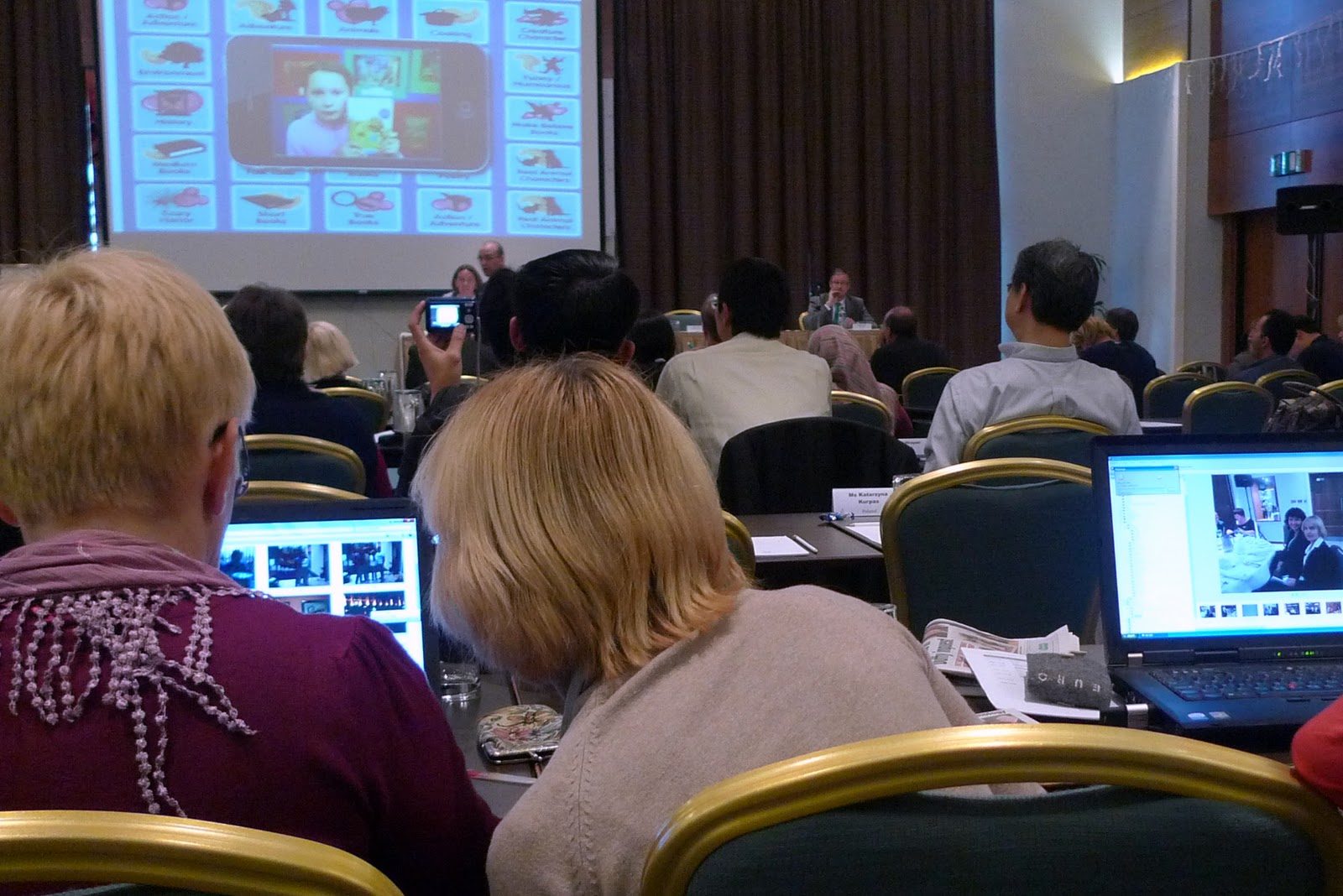
Back from the 10th AEC-NET (Asia-Europe Classroom Net) conference, my mind is buzzing with ideas. After many years of coordinating AEC-NET projects, and preparing project presentations for the conference, this time round I took the backseat, to be able to observe and reflect. The Singapore admin team, together with the Irish conference hosts, had put together a hectic 5 days of lectures, workshops, presentations, and project group meetings, under the title 'Apps in Asian and European Classrooms! Unleashing Educational Creativity'.

Schools in most participating countries have definitely moved on. There is serious talk about taking action, and not just marvelling at philosophical ideas somewhere in a distant 'cloud', as used to be the case a few years ago. Many schools are technologically quite well equipped - some have even moved into the 1:1 laptop or iPad era, like my own. The hardware is there but now the question is how best to utilize it to enhance learning, and engage our 21st-century students.

The conference scene has changed a lot, too - screens of different sizes abound amongst the audience

One afternoon we had a dynamic 5-workshop 'speed data' session, with app after app presented at a breath-taking tempo. Tagxedo word clouds, Animoto videos, Geogebra, Audacity, Google apps, Vimeo, Kinect Scratch, blogging services, Etherpad... An endless list of applications and gimmickry was blast onto us, like a firework show. I wonder what the more techonogically novice teachers thought, as even I, with at least some previous exposure and knowledge, found it challenging to follow! I started to think that while it is certainly useful for a teacher to have a digital "toolbox" of various apps, for example, to visualize complicated concepts, in the end, using hundreds and hundreds of these apps all the time is not the key issue. True, this session kept us teachers awake and running, in the after-lunch sleepy hours, and would probably work to do the same for students, but something more solid is needed to shift educational practices.

One of the most interesting presenters for me, was Ms Chan Lai Peng, Deputy Director from the MOE in Singapore. Having organised some student exchanges, and virtual projects with schools in Singapore, I have realized how much our two small nations have in common, despite the striking geographical and cultural differences. Both nations, with small populations, have competed for the top positions in the OECD PISA assessments, for example. Ms Chan explained to us how they have come to the 3rd Master Plan concerning ICT in education. Vigorous programmes have been put into place to deepen the pedagogy of ICT use, and for each school to reach a base line standard in ICT integration. A lot of attention is paid to cyber wellness programmes, with student ambassadors to tutor their peers in every school. What's more, every school has a full-time technical assistant on site - something that we Finnish teachers can only dream of! Ms Chan finished her lively talk in this observation: "Technology is but a tool but it can be a powerful one when put in the hands of skillful teachers." It is our challenge now, as teachers, to keep updating and developing our skills to keep up with the fast pace of change.

Saturday, 15 January 2011

Writing for a purpose does make a difference


In my constant search for authentic language use opportunities for my students, I engaged one English group in a small project, proposed by a colleague in Sweden. Actually old-fashioned letter exchange. We received letters, written in English, from a Swedish class before Christmas, which I then distributed to my students to read and reply to. They were ordinary introductory letters, in which the students colloquially wrote about themselves, their school and studies, family and hobbies. In addition, my colleague had asked them to reflect on the similarities and differences between the cultures of our two neighbouring countries, and insert a picture depicting something typically Swedish. All this went quite nicely with our curriculum, and the syllabus of the course we are studying at the moment.

I was positively surprised that my students seemed to take a genuine interest in this task - in contrast to the common boredom with textbook exercises. The letters they received were quite long, and interesting, and the familiarity with Sweden was another positive factor that made them read with enthusiasm. As for writing their replies, the fact that the recipient was another young student in another country, made them tackle the task differently from ordinary homework. We discussed aspects of politeness, political correctness, cultural sensitivity, and trying to be interested and interesting in general. As the letters were typed on the computer, I also reminded them about the use of automatic language check programmes to avoid spelling mistakes, for example. I also asked them to add a similar picture of Finland, and we discussed 'Creative Commons' and the preferable use of their own photographs, to make it more personal, and to avoid any issues with copyright.

Here are some reflections on the pluses and minuses of this small project.

HIGHLIGHTS
  • Authentic language use for a real purpose.
  • An assignment that required a personal response from the students - not just totally disconnected exercises from a textbook. Real interaction called for a more creative approach, sometimes also humour.
Dear Finnish random awesome person
REPLY: Dear Swedish not such a random person anymore
  • Most students paid special attention to writing correctly.
  • Many students wrote much better, and more interesting and entertaining letters than they would have done if there was no real recipient.
  • The realization that it does matter what you produce, and it does reflect a lot about you as a person.
  • I learned that the Swedish class used Google Docs and process writing for their letters. Unfortunately, I didn't have the time to incorporate the full cycle of process writing this time, but will definitely look into using Google Docs in this way in the future.

CHALLENGES
  •  In every group, there are always students who just won't make an effort - some letters were short, off the cuff, and consequently not very interesting.
  • Despite all the coaching and preparation of the task, some of my students produced letters filled with typos!
  • Some didn't bother to attach a photo.
  • Uneven numbers of students in the two groups - I had more, so some of my students ended up writing a reply to the same person. It didn't matter for this one letter, but having 'personal penfriends' would be difficult to carry out in the long run.
  • I think, interest would soon fade we the letter exchange was continued. It was a good, one-off project, though.
Hopefully we will be able to continue and develop our collaboration in some way in the future!

Monday, 28 June 2010

It was good as long as it lasted

WARNING: This will be a sour grapes rant!

July will start in a few days. And with that, I will finally have to make up my mind what to do with my couple of Ning networks. The latest email from the Ning Team tells me the following:


I had been led to believe earlier that the Mini deal would be free for all schools, but it now turns out that since I'm outside North America, I will have to start paying, even for Ning Mini. Actually, even free Ning Mini wouldn't have helped me with my international projects, which I have been running for the last three years, as the membership has exceeded the 150 allowance of Ning Mini. However, I was hoping to still be able to run smaller projects free, even after the Ning changes took place.


I know, I should have seen this coming. There is no free lunch. Even so, I feel I've been given a rotten deal here. My school won't pay to keep the old Nings running, nor to start any new ones. I was told to go back to the platform my school offers - Moodle. There was a reason why I abandoned Moodle three years ago, though. Ning was so much more user-friendly, and appealing to young people. I know, even more reason why we should pay for using such a slick service! But I don't think it will now be an option for many in the public school systems outside the US. In principle, I am not willing to start paying for the school Nings out of my own pocket. Many people say that it's not the tools, it's what you do with them. Quite right, but after driving a sportscar with all the modern bells and whistles, it won't be so much fun being behind the wheel of a basic saloon again. School will once again be further removed from what the real world has to offer.

Another unfortunate consequence is losing the 'digital footprint' created in the earlier projects. Naturally, I have got some screenshots and statistics, plus presentations I have made about the projects, but most of the student work will just disappear into thin air. True, the quality of all of some of the student work leaves a lot to be desired, and I'm sure the Internet is already bursting with too much 'virtual waste'. But as a teacher, being able to refer to what has been done before, might be worthwhile in the future. International school project work is a continuous process, and documentation of it an essential part of moving ahead. Not to mention the transparency factor of anybody being able to see and assess the work online. What's more, I feel responsible for all the partner schools around the world, all the hard-working teachers and students, who have invested their faith and trust in this project, and who will now see all their efforts wasted. Many of them will lose the links they have created to the project site from their school webpage.


Looking at this map, I'm now wondering if it might be different if some of our partners were in North America? There is already talk about Finns creating their own social network services, in order to keep all the copyright and other issues strictly inside our own borders. How does that support the idea of bringing the world closer together, and more globalized education?

I am not looking forward to starting to decide how much, what and in what format to save some of the work of last year's project. I could think of better things to do during my summer holiday.