Thursday, 7 June 2018

Hello, I'm back!

Wow! Three and a half years since I last wrote in this blog! What on earth happened?

Well, all sorts of changes in my school, resulting in very busy school years. Also, a new curriculum, with the demand for more and more "varied and ongoing" assessment, i.e. marking, marking and still some more marking. On top of this, most student assignments are now online, quite rightly, of course (it's the 21st century, after all!) but, from a teacher's point of view, marking online is far slower than it used to be on paper. Endless evenings and weekends spent staring at the computer screen, with dry eyes, aching back, shoulders and wrists. And last but not least, I'm sure age is getting to me, too. Irritatingly, I seem to take much longer, first to even get started, and secondly to finish any school work. Procrastination is so much more tempting!

So there, in short, some of the reasons for this long gap in writing about education. But here I am now, at the start of another long and divine summer holiday we teachers in Finland still have the privilege of enjoying, and I feel my mind needs some unwinding, which could be greatly helped by writing down some of my thoughts and ideas again.

I might start with a free online course I signed up just this week. Helsinki University is offering this opportunity for anybody in the world - the course Elements of AI is in English.


AI is on everybody's lips these days, and I have also done a few units on it in my English courses. Yet, as I feel that my own understanding of the whole concept is so vague and superficial, I jumped at the chance of starting this course. Not only will I be focusing on my own learning of the topic but also familiarising myself with how such MOOC-type courses are done these days.

I have now finished the first unit of the course, and got a basic idea of the key concepts for explaining AI. I have also thought about realistic and unrealistic (e.g. science-fiction) AI and read about some philosophical problems related to AI. Very interesting! The required exercises, both multiple choice and open-ended, have been rather challenging and really made me use my resting brain cells in an invigorating way. And, I've also started thinking about new ways of assessing students' online work - peer reviews sound like a workable idea that I haven't really utilised so far.

Looking forward to continuing the course, with the aim at finishing before the end of my summer holiday on August 9! From my experience so far, can warmly recommend this course to other teachers like me, who have a hunch of AI but no in-depth grasp of any of it yet.


Monday, 8 December 2014

Videos in EFL classes

I have been using various videos in EFL lessons for years. Not only are they great sources of current news and information, and captivating visual input to bring any topic alive for the students, but, of course, they also offer great opportunities for engaging students in language practise. For example, I make use of them to introduce a new theme in our textbook, or give students a novel point view of a topic, after studying a particular unit first. Sometimes it's just watching it in class, and then having a short discussion or highlighting certain vocabulary. Other times, I prepare questions, writing or group discussion prompts based on the contents of the videos. In short, there are dozens of ways of creatively using videos to help students learn English!

Recently, anticipating the new digital national final exams in Finnish high schools to start in only two years, I've been hunting for tools to digitalise some of these exercises, even to use them in my course exams. With no funding from my school for any tools, and not wanting to invest any of my own money in this, finding totally free tools has not been easy. Nevertheless, here are a few I have come across.


screenshot

I was really happy to find this website a few weeks ago, and initially thought all my problems were solved at once. eduCanon seemed to have all the features I could have dreamed of in one neat package. You can crop the videos, and there seemed to be a good selection of different question formats you could use, not to mention facilities to track each individual student's progress and differentiating tasks based on students ability. Unfortunately, was too good to be true, as so often. Eagerly preparing my first video task, and wanting to use the various question formats, I realised, to my great disappointment, that only multiple choice was available in the free version. Too bad, it's good-bye to eduCanon for me.


Screenshot2

With EDpuzzle, another free tool, I managed to make a video exercise in no time at all. It was quite nice to be able to add my little voice messages here and there, and in addition to multiple choice questions, I could also choose open-ended questions and answers. Cropping the video worked fine, and all in all, seems a good alternative. Yet, I started thinking whether, for my purposes, having the check-up questions interrupting the video at particular points chosen by the teacher was the best option, after all. Also, wouldn't it still be better for the students to see the questions or tasks first, to then focus their attention better during the listening? Hmm, I wonder.

3. Google forms 
We are currently using GAFE at school, so I went back to the free apps provided by my employer. A new feature in Google forms now allows teachers to add videos, too. Here students can be guided to watch the whole video first, to get the "big picture" so to speak, and enjoy the pictures, too. Only then should they check the exercises and watch and listen again for the detailed linguistic input.

Screen Shot 2014-12-13 at 9.07.56 PM

Another advantage, for me, of using GAFE is that students already have their IDs and accounts through school, and no extra sign ups and sign ins are needed. That would have been a bother with the two previous options. The less hassle with teenagers, the better, I have realised.

The disadvantage with Google forms, is that it doesn't really embed the video but opens it in YouTube, in a new window, which will lead to switching screens and slightly irritating clicking. So, hey Google, why not fix this - or is it maybe a question of copyright?

Overall

You might think what the big thing about preparing digital video tasks for language classes is. Surely, you could just show the video via the projector for the whole class, and give students worksheets with the questions. Sure, you could do that, and how much easier it would be. But such a passive exercise! Many students wouldn't even bother to make a proper effort. What's more, their levels are so wide apart that a message that one student could easily work out with only one listening, would take another several attempts to understand. The pace in a teacher-centred approach would never be right for anyone in the end.

This is why, I much prefer a more personalised lesson, with several videos on offer, and students proceeding at their own pace, alone or possibly working it out in pairs. I like to encourage team work in my lessons even if many of my students are not very good at it. Some find it extremely hard to discuss the answers with another student to enhance both of their learning outcomes. This is possibly due to the still prevalent individual student assessment, which pushes them to do everything on their own. It's a real pity!

Saturday, 18 October 2014

To limit, or not to limit technology use in the classroom?


technology1

I used to be very pro-technology, and tried to incorporate up-to-date digital content into my English lessons. But, to my horror, more and more often I find myself wanting to follow media guru Clay Shirky's surprising decision to ask students to put their technology away in class.

First off, from my own experience, I have realised that multi-tasking really is a myth. If your job is to truly learn something, or accomplish a task, you will need to focus! Gadgets on the desk  are too tempting, and greatly distract students from focusing on the tasks at hand. Secondly, when we are trying to learn a foreign language, where communication and social interaction plays a huge role, why should we practise this with screen barriers between us while we are in the classroom together? Surely, it's more productive to talk face-to-face, maintaining eye contact and focused presence. And thirdly, students get enough "tech time" outside the classroom, so it's not healthy for them to spend their whole school days as well, glued to the screen. Having said this, I believe extending lessons with relevant online work for homework is often a good idea.

Technology2

But, as always, there's the other side of the coin. Today's teens find it harder and harder to tolerate old-school "hard work" learning. They need ever-changing activities and flickering screens to get involved. This is where technology comes to our rescue. Pacing a 75-minute lesson with some online activities provides a welcome change in the working rhythm. A case in point is the recent hype about Kahoot, and no doubt it does instantly hypnotise a whole classroom into short snacky-type activities. Here is what I blogged about this energising effect of Kahoot in more detail earlier. Yet, you can only use it so much with any one group. The "seen it, done that" syndrome soon hits in, and we teachers are left hunting for the next temporary online remedy.

Maybe this is the future of education - teachers' job consisting more and more of curating different applications to keep their students on task? Unfortunately, for the time being, we are still missing attractive and engaging enough game-based programmes and applications, to facilitate, for example, individually adaptive grammar learning. Consequently, many teachers already burn out under this pressure, spending all their time fishing the net for the next great app. We should get language teachers and cutting-edge professional game designers together to develop these!  I do believe that we teachers are also entitled to a life outside school, irrespective of whether we see our job as a vocation or just a job.
There must be a golden half-way measure in all this frenzy until pedagogically sound and user-friendly online learning applications are widely available. At the moment, I balance my lessons with a hybrid approach - tasks where all gadgets are put safely out of sight and reach, and others where laptops, tablets and sometimes even smartphones are in active use.

Tuesday, 7 October 2014

Can an old dog learn new tricks?

Our friends' old boy would definitely opt for taking it easy!

When I was doing my teacher training (eons ago!), we used to have to write to-the-second lesson plans, in which we even had to anticipate possible students answers to our questions, and then write down reaction and intervention alternatives to them. Back in those days - in the last century - school seemed so much simpler than today. Every classroom had the neat, straight rows of desks, the teacher's word was the law (or close to it anyway), and mostly, the students didn't question this reality.

It's a different ballgame now. My 16-19-year-old students get restless after about 10-15 minutes if they need to focus on one learning task that long. They can't part with their smartphones, which sit on their desks, within easy reach - and they DO reach for them, the moment there is even a momentary lull in the lesson. For many of them, the phones, or alternatively tablets or laptops have become almost an extension of their bodies, and they feel rather lost if a nasty teacher asks them to put them out of sight for a while.

So, the question is, what should be done to avoid the inevitable friction between today's students and teachers trained in the 20th century? We had a mandatory in-service training day last Saturday, with a keynote speaker from Helsinki University, Professor of Educational Psychology, Ms Kirsti Lonka.

The title of the talk was 'Plunges into tomorrow's learning', where instead of ready-made, clear, structured answers and guidelines, Professor Lonka threw us possible ideas and scenarios what that future learning at schools might look like. Surely, it's up to all of us teachers to start redefining our role and renewing our classroom practices, or our students' spark for learning will soon be totally lost, and they will just waste their school days, mindlessly entertaining themselves on their gadgets. One thought that stuck with me was that although there is no doubt that teachers will still be very much needed in the future, they won't be needed to deliver information any more. If you define your role as a a teacher in 20th-century terms, aren't you perpetuating an old-world paradigm that will possibly fails to reach the kids of the digital age?

Serendipitously, today I came across Scott McLeod's blog where he says the following:
You want student learning to change but you don't want to change teaching or schooling. Good luck with that.
Good luck indeed! I am quite concerned about the apparent lack of many students' motivation for school work, so what could I, as the facilitator of student learning, do to help them? Traditional school practices are still the norm, and most of us will probably stay firmly put in our comfort zones, fully believing that that's for the benefit of student learning. What baffles me, though, is how long educators have been wondering about these issues, with the same problems and questions cropping up again and again, and still not much changes, other than maybe in individual schools or the classrooms of individual teachers!

One step forward would be to drastically change the arrangement and design of learning spaces. Here's a time-lapse video of an experimental, flexible and adaptable learning space at Helsinki University. A far cry from the desk rows in the old school, don't you think?


Thursday, 9 January 2014

Energizing the classroom

With Finnish high school students, too often the problem arises that the atmosphere in a classroom drops into apathetic lethargy, especially in morning or late afternoon lessons during the dark winter months. For a teacher, it's frustrating trying to activate such groups of dozing off teens. Asking questions, and ending up answering them yourself, or seeing some students totally preoccupied with their smartphone messages, or Facebook updates on their tablet,s is tantamount to soul-destroying. I know, look in the mirror! Give some serious thought to your last century methods!

Luckily, there are now some easily accessible and adaptable online tools to wake your students up from  such stupor. The latest one I've tried is called Kahoot.


It is defined as a "game-based blended learning & classroom response system". With Kahoot, a teacher can create quizzes, discussions or surveys, with multiple choice answers. You can even add pictures to your questions, and Kahoot is working on facilitating adding videos, too. The teacher also sets the time needed to answer each questions, e.g. 20 or 30 seconds. A completed quiz or survey is then projected onto the classroom screen, students sign in on their smartphones, tablets or laptops, using a key number given by their teacher and a nickname, and the game can start.

The teacher is in charge of moving on from question to question, students read the question and the alternative answers on the screen and click the answer on their touch screens. The programme even provides suspense-creating background music while the students are choosing their answers. Once the given time is up or once everybody has given an answer, the programme automatically shows the score - i.e. how many answers for each alternative. This is a good time for further explanations and clarifications if the teacher realises that many students didn't get the right answer. After this, an important part follows: the nicknames of the top 5 fastest students are revealed! Initially, I was a bit doubtful whether 16-19-year-olds would find this type of activity rather childish but the few times I've tried it so far, I have been positively surprised. The competitive urge seems to be very strong, especially among boys, I've noticed!

At the end of each game, the overall winner is revealed on the screen. What I find very good, is that nobody will have to feel afraid of failure as it's only the top 5 who get mentioned each time. Nobody knows how the rest did, or who scored the lowest.

What have I used Kahoot for then? I prepared one grammar quiz to check if the students had learned how to use the English genitive correctly. It went very well. The students seemed enthusiastic. Everybody was involved. And you should have seen the excited, smiling faces all round the classroom! The shift of energy levels was remarkable. I was also pleased with the chance to get instant feedback of what they had learned and what still needed to be re-explained. This group were 1st-graders in a Finnish high school, i.e. 16-year-olds.

Today I experimented with our seniors (18-19-year-olds). I was a little bit concerned that they would find it a waste of time, but quite the contrary. I was introducing a text dealing with BBC documentaries on indigenous tribes around the world, which we will study in our course book. We talked about indigenous peoples in general at first, and the students then watched a YouTube video from this BBC series, depicting the very tribe in Ethiopia that they would read about in their book. I asked them to listen carefully to all the information given about the tribe, and also watch carefully for all sorts of interesting details as they would be quizzed about their observational skills afterwards.

After the video viewing (some 9 minutes), I asked each pair of students to switch on either a smartphone, a tablet or a laptop. This year, our school has adopted the BYOD system and we have a well-functioning wi-fi system all through the school, so no problem here. The group were a little bit mystified at first as smartphones are not often used in class. They soon got into it, though and we played this Kahoot quiz, which just asked simple little trivia questions based on the video.


The language content of this activity wasn't very impressive but I feel it did the trick of introducing the topic in a fun and certainly engaging way. It happened to be the last lesson in the afternoon, and the whole group got wide awake and took part eagerly. Also these older boys showed their competitive spirit!

I am definitely going to use Kahoot in the future, too. The programme also includes a simple thumbs up / thumbs down evaluation feature at the end of each game, and so far the students' feedback has been very positive. What's more, for busy teachers there are thousands of public quizzes prepared by others available for anyone to use, so it's worth browsing whether something might suit your lessons. 

Luckily, in our school system, we get to teach totally different groups 5 times a year, so I don't think this will get boring very soon!

Tuesday, 11 September 2012

Global education requires swift moves

Time never stands still when you are grabbing online opportunities for more authentic and meaningful student learning.


I can remember back in 2010 when my online colleagues, Tania Sheko from Australia and Marie Coleman from Florida US, set up the collaborative photo sharing project Through Global Lenses for our students. The idea was born, developed and implemented within a few weeks. Pure innovation and bold pioneer spirit!

I feel similar skills are needed in more and more jobs these days. Long gone are the days of static, routine work in many careers. As a teenager, and all through my university years, I used to always work in a post office during the summer holidays. Especially July used to be quite a quiet month with so many offices and factories closed for the workers' summer holidays. Consequently, I was often able to spend long working hours secretly reading a novel under my counter as hardly any customers came in. Today, there are hardly any post offices left! At least in Finland, they have been merged into kiosks, and grocery stores, making these places far busier for the workers as a result.

Yet, schools are still trying to hold on to the old industrial model of restricted curriculum, and yearly repeated lessons of going through static textbooks. How is this preparing our students for the world outside school? I can see the difficulty, though. If I was following a textbook with my EXE English group, I couldn't possibly spare my valuable few lessons to jump at the chance of international collaboration as I'm doing now.  What a pity it would be to lose such unique opportunities of real-life learning!

Since last Friday, the new blogging interaction initiative between my school in Finland, and Melbourne High School in Australia, has proceeded in leaps and bounds. Several tweets have been exchanged between us teachers, for one thing to tackle both our comment settings. Students are using either Posterous, Blogger or Wordpress as their blog services, and all of them require different specific sign-in procedures, making it difficult or even impossible for students to write comments. We have now opted for open commenting to make things easier. Of course, it is advisable to monitor comments closely in the blogosphere, especially when it comes to under-age students. At the same time, though, closed platforms are rather restrictive for any international collaboration. Naturally, we teachers will still keep an eye over the comments, and take necessary moderating measures if things get out of hand with spammers or inappropriate anonymous commenting.

Another new development over the weekend, too. The international "lady trio" has joined forces again, and Marie from Florida will have her blogging 'Introduction to Technology for Education' students visit our school blogs to get a first-hand glimpse into what is done in some schools today. 

Learning has suddenly become so much more vibrant and relevant for all of us again!

Saturday, 8 September 2012

Connecting classrooms through blogging

Last spring, there was an attempt to get my blogging students into some meaningful exchange with my online colleague Tania Sheko's blogging classes in Australia. Unfortunately, due to several reasons, it never really got going. Firstly, it was our last few weeks before the long summer break, and a lot of other activities going on at school. Secondly, we noticed that the Posterous blogs used in Melbourne high school, were sometimes set to require a Twitter sign-in for the comments. As my students didn't have Twitter accounts, they were unable to leave comments. And there were other complications and delays, as usual in a school setting. To cut a long story short - it all fell flat in the rush of our last few weeks of the school year.

Come this new school year, and I decided to start looking for blogging partners much earlier. Having the experience of a whole year of blogging with students, I felt much more confident about it, and guiding the students was easier and quicker right from the start. I kept last year's concept of a class blog with links to student blogs in the sidebar, as it worked so well that I didn't feel any need to change it.

The beauty of having a small online PLN is that serendipity often plays a part in international collaboration! I had barely got my students to set up their individual blogs for this year, and had had no time yet to get any partner searches started, when I received this message on Facebook:


This was only two days ago, and already Tania has managed to get English teacher Nick Fairlie onboard, and some of their year 9 boys have also commented on my students' first ever blog posts. What a wonderful surprise for my newbie bloggers! Nick and Tania have also set a writing task for this coming Wednesday. It will be a good challenge for their students to apply their intercultural communication skills when writing to an authentic audience on the other side of the world. And afterwards, of course, a perfect chance for my students to get used to REAL commenting.I couldn't wish for a better start to expose my EFL students to using English in a real-life context!


Blogging is truly doing what Tania wrote about in her professional blog - 'Connecting our students to themselves, each other and the world'. It really is worthwhile looking at Tania and Nick's slides about their blogging process so far!

Friday, 17 August 2012

Something new for back to school


One week into the new school year already. And I am still fumbling to find the online tools that I want to use with my EFL groups this year!

I like blogs, and will use one for my "own" English group again. The structure of one joint class blog, with links to students' individual blogs and our course schedule in the sidebar, worked really well last year, and I want to repeat that. But for the rest of my groups, I will have changing groups and courses every 6-7 weeks, and 14 of them during the whole school year. Setting up 14 separate blogs for such a short duration really seems too much handle, and a bit of a waste to me.

I need something with easy access for students, where I can post/upload/link material outside the textbook and where students can easily interact with each other to put their English into real use. Possibly also for publishing some student work. I thought of a wiki but even that seems too heavy a solution for my needs at the moment. I'm more and more leaning towards a Facebook group or page. I should ask my students how they would feel about it. I have this suspicion that they might feel that school is invading their free time network by suddenly posting homework assignments and other school-related info on Facebook. But it would be so easy! No need to spend class time explaining how a new tool works, no separate sign up procedures and new passwords, no hassle! (I assume all my students are on Facebook - I may be wrong!)

Why do I want to have an online "place" for all my courses then? My main urge is to move beyond the restrictive textbook, and the numbing busy work of gap fills in them. Topical, up-to-date online material is so much more interesting and relevant! Just this week I read quite a provocative guest post by a high school senior in Scott McLeod's blog. This student's criticism on teachers and textbooks is rather hash:
...the more and more they use textbooks, which is the easy way to do things, the worse they will become at teaching and inspiring their students to actually want to learn. That is why textbooks have become the crutch of high school teachers. They are so incredibly easy to lean on, but if they were taken away many teachers would be absolutely lost because they have not challenged themselves to create more of a 21st Century learning environment in their classrooms.
But I must say, I agree! Interestingly, a young Finn also wrote about language teaching/learning in high school in our local paper last weekend. According to her, she never learned to really express herself in a foreign language with the help of the eternal worksheets and translation exercises that she was bombarded with in every language class. When she was faced with a real foreigner who asked her something, she simply couldn't say anything because she didn't have the cues or ready-made alternatives to choose from given to her on a piece of paper!

I wish to activate my students to REALLY use the foreign language for interaction and communication. That's what I need a social networking tool for.

Photo: Tesco by thinkretail on Flickr

Saturday, 19 May 2012

An EFL project - Scoop.it and blogging

My blogging students are finishing their third and last EFL course this year. The curriculum topics for this course are 'schools, education, learning' and 'employment and job applications'. I wanted to try some project work to introduce my students to the wealth of publicity our Finnish education system has been receiving for a few years now. By going through some of this media material, the goal was to write their responses to what they found out in their own blogs. I was hoping that this process would result in some higher order thinking.

I had collected an impressive list of links to online articles, blog posts and videos that I wanted to share with them as their background research material. I wanted them to learn relevant vocabulary by reading a bulk of articles and watching many videos where the same vocabulary would be repeated again and again. Ideally, we would have searched for the online material together but unfortunately, we didn't have the time within the busy 6-week course of 3 lessons a week. But how to make this list inviting to the students? I could just about imagine their long faces if I presented a dull list of written hyperlinks in the course blog! Then I came up with the marvellous idea of creating a Scoop.it magazine out of the links. Straight away the articles and videos looked much more attractive. My students were at least mildly interested when I introduced the project with the accompanying materials titled FINNISH EDUCATION IN SPOTLIGHT. I think their scepticism came from the apprehension of how much work all this would involve and how demanding it would be!


I posted the initial project guidelines in the course blog, also introducing the idea of Bloom's taxonomy to inspire them to dig deeper. This was also discussed in class. After this, the students were off to do their background research, mostly at home but we also spent some class time on it. Firstly, I wanted to touch base with each of them to see where they were at. Without supervision, many of them tend to procrastine too much. In class I was able to offer some tips on what to focus on, and how to start planning their eventual blog post early enough. Secondly, I wanted to give them a chance to ask their peers or me if they encountered any problems. We also discussed their findings together so they could get some more insights. And as Scoop.it kept suggesting more and more links, the pages of the magazine kept increasing. Students didn't complain, though!


For these classes, we often used the new, modern learning space of our school, where the students could make themselves comfortable on the couches. I expected them to have lots of questions but they seemed to be very self-directed and assured me that they were proceeding well. Some had their notes on their laptops, others preferred a handwritten notebook. I had to fight hard to stay in the background, available if needed but not interfering and "orchestrating" all the time. These are the sort of classes that I would like to do more often!

As the deadline for their projects was approaching, I decided that we would spend one whole 75-minute class on finalising the blog posts. This would give them the chance to still ask for any last-minute advice. The day before this class, it was a public holiday, so I posted final advice on the course blog as I knew many of them would be frantically working on their project at home (last minute panic is very common amongst them - but then again, I'm the same!). In my advice post, I also tried to model the kind of writing I expected from them, with hyperlinks to the Scoop.it materials. I'm so happy now that we had the last class finishing the work together! It was then that I noticed that, after all the preparation and explanations, some of them hadn't grasped the idea of a hyperlinked blog post at all, or how they were expected to refer to the material they had studied. I was quite surprised and disappointed at first. I thought I had given them such thorough and clear instructions! On second thoughts, I realized that they had probably never done such source-based writing before, or if they had, it had been in the traditional paper format, with a list of sources listed at the end. Luckily, I was able to go through the idea of hyperlinked online writing once more, and most of them finally seemed to get the point as it's was relevant to their work at hand!

What was learned?
  • Students got their work done in the end - all at their own level. This type of work allowed personal approaches, and some did manage to demonstrate deeper and more analytical thinking. I'm really proud of them!
  • Scoop.it is brilliant as a repository of study links! (In addition to being a nice way to curate a topic for your PLN.)
  • Next time, do more process writing - students benefit from ongoing hands-on guidance.
  • Maybe try something like this in pairs - collaboration might prove fruitful.

Why not check some of their work through the links to individual student blogs in the sidebar of our course blog! COMMENTS ARE MORE THAN WELCOME!

Saturday, 17 March 2012

Connecting my blogging students

We have now gone through two English courses without a textbook. We have used a lot of online materials (texts, blogs, pictures and videos) as material. The class blog has been the "online hub" to provide the links, give instructions, and motivate students. And the individual student blogs (also linked to the "hub") have been the platform for writing practise and conversations through comments.

As all this was totally new for me as well as for the students, I thought it was necessary to practise in our own little community first. Especially commenting is something that doesn't come naturally to most students. It takes a lot of guidance for students to realize what it really means to take a genuine interest in what other people have written, and to initiate conversations through their comments. In addition, writing to an unknown online audience is very different from only writing composition for your own teacher to read and assess! How do you catch readers' attention with your blog post? What culturally bound concepts will you have to explain to non-Finnish readers? What can you write in a public forum? How about privacy and online safety issues? All these, and many more, questions have come up in the course of our blogging journey so far.

If anyone is interested in more details, here are the links to my previous reflections on the first stages of student blogging:

Blogging with students 1 (why + setting the online "hub")
Blogging with students 2 (starting individual students blogs)
Blogging with students 3 (students' first blog posts)
Blogging with students 4 (commenting)
Blogging with students 5 (lots of positive progress in our 2nd course)

But now I feel it's time to start looking for student partners outside our own school, to make the blogging experience more real and authentic for my students. I am confident that they are now ready for it, and will be even more motivated, knowing that there are real people somewhere to connect with.


Through my years of doing international school projects, I have always believed that authenticity, in one form or another, is essential in foreign language learning. And now we have the chance to easily connect with schools around the world, thanks to wonderful ICT tools! The international projects I used to do before, where done as optional credit courses for interested students. Now I'm moving towards making such project work part of each and every English course I teach, with the goal of exposing all my students to real language use during their school years.

But where to find the partners? Internet serendipity again! I noticed that my online colleague from Australia, Tania Sheko, had just started blogging with the Yr 9 boys in her school. Of course, I was curious to see what they were up to, and was so amazed to read the mature responses of only 14-15-year-old boys to a demanding topic "You are what you know" that I just had to start writing comments. One thing led to another, and I have now promised to have my students do some commenting on these boys' blogs, too.

It's really worth reading Tania's reflections on her students' blogging. I share her views whole-heartedly, e.g. the following:
So much learning takes place without much effort though – writing not just for your teacher and a mark, but for a peer audience and a potentially global readership, will open up the scope for authentic discussions and social learning.
I can't wait for our next course to begin on April 10th, to get the interaction going! I welcome others to read and leave comments, too. It would really open up the classrooms to the world,  for both the Australian and our Finnish students.

Photo: connect by katypang on Flickr

Tuesday, 21 February 2012

We should teach copyright to students

I was really pleased to read the following in one of my students' blogs recently:
P.S. Sorry about the lack of photos. You can’t believe how hard it is to find a picture that is legally usable in a blog. It’s like you’re looking for a needle in a haystack.
Yes, my banging on about the use of photos seems to have sunk in! With this blogging group of 15 students, it took me a couple of months of constant reminders until the students took to heart all the copyright advice I gave them, both online and orally in class. And now it's great to see how concientiously they look for photos with Creative Commons licences, and credit them in their blog posts.


As the world-wide web is such a treasure trove of material, I can understood why so many of us take it for granted that it is all there free for anyone to grab and do what they wish with. Even some popular recent services cause confusion amongst users. Here in Finland, the apparent copyright infringements in the use of Pinterest have caused a lot discussion recently. Especially women seem to find it irresistible to compile and share beautiful pinboards of their favourite pictures - usually totally ignoring any copyright issues. It's worth reading, for example, this article on the many concerns with Pinterest.

Another popular service among teachers is Glogster Edu. I am planning an in-service session for language teachers in my area, in which I intend to introduce some useful and fun net resources. I was going to include Glogster in it but decided not to, as I simply won't have the time to get into Copyright issues in any depth. Glogster certainly motivates students to create their own, colourful, multi-media posters but it inherently leads students to copy material online - mostly illegally unless their teachers are strict about it. Naturally, like Pinterest, also Glogster has clear instructions on 'Uploading of Intellectual Property' in their Terms of Use. It's another question, of course, how many teachers follow these instructions.

I wonder how many schools have a joint policy about copyright that all teachers know about and consistently adhere to - both in their own PowerPoint presentations, and in their requirements for students' work. I feel that it is every educator's duty to model the right use of online sources and materials.

Sunday, 19 February 2012

Blogging with students 5

I have just finished my 2nd English course with my blogging group. What a pleasure it was to start work with them as their blogs were waiting, and they were already familiar with this type of work. I, too, had learned many valuable lessons during course 1, and was consequently better prepared and comfortable with the new concept. Thanks to all these advantages, and the ground work done in course 1, we were able to focus more on reading new texts, watching videos, class discussions and writing 3 separate blog posts with the accompanying comments.


As before, I based the course on the national EFL curriculum topics, and published the course plan online. This time, however, I gave the students more freedom to choose their blog topics. Following the 3 course themes, they chose what and how to write themselves. This seemed to work quite well, and some of the students also mentioned this as a positive aspect in their course feedback.

Unlearning repeating linguistic errors is quite a challenge. Students wrote drafts first, I gave them tips and feedback, and then they rewrote and edited their post, before publishing it. Despite all this effort, the same errors mostly recurred in their next drafts! What would help them actively tackle these ingrained errors? Or am I being a pedantic language teacher again, or maybe too impatient?

Commenting developed in leaps and bounds among some students, whereas those who struggled with their motivation and generally applying themselves in course 1, degenerated even further this time. In our last course, later this spring, I will work hard to get some collaboration going with foreign partners, to make the blogging and commenting an even more realistic experience for the students. Another thing I will try in the next course, is more regular, shorter blog posts, with even more student freedom to choose the topics. After all, this is what blogging inherently is about, rather than writing given assignments, and even some students specifically hoped for this type of change in their feedback.

All in all, I enjoyed the classes without coursebooks more and more. There are so many more opportunities for student involvement and engagement than with the pre-set, rather mechanical gap-fill exercises that coursebooks are filled with. Every class was filled with English chatting, questions being asked, vocabulary use negotiated, ideas thrown in, and students actively participating. In December, we hosted a student exchange visit from a partner school in Singapore. The Singaporean guests visited our class, and students carried out interviews to find out about young people's lives on the other side of the world. The information they collected could then be used for their blog posts, which many of them did. I wish I had videoed the non-stop, enthusiastic talk that went on in that class!


For anyone interested, the students blogs can be found in the right-hand sidebar of our course blog.


Sunday, 5 February 2012

The hurdles of 1:1, LMS and school change

It has been a very interesting and hectic school year so far. In September, all 130 first-graders got their brand-new minilaptops. School administration proudly named this the beginning of the BIG LEAP. At the same time, our school acquired a LMS to help teachers take the leap in practice. Having been actively involved in social media, and various online platforms for some time, I was asked to guide teachers in the use of the new platform, together with our ICT teacher, who would be the technical expert. After a lot of initial doubts concerning my personal leap outside the language teacher's "box", I decided to jump at the chance of new challenges.


In my role as a teacher tutor, I soon realized that my colleagues could roughly be divided into three groups: 1) those who already had some experience in integrating technology in their classes, and thus had specific expectations of what a LMS should offer 2) those who were ready to start experimenting with new technologies but had now clear idea of what it might be 3) the ostriches who had their heads safely hidden in the sand, and maintained that as long as students learned the facts listed in the curriculum in the old way, no technology would be needed in their classrooms. They also added that as no computers would be used in the national final exams, for the foreseeable future anyway, using them in class would be a waste of time and effort.

Unfortunately, the adopted LMS turned out to be a disappointing flop. It didn't meet the expectations of group 1, among other things because it wasn't customisable in any way. Group 2 found it too intimidating to use, and needed frequent step-by-step instructions, which in the end were too frustratingly time-consuming. As for group 3, I think they consider technology too much as a tool for TEACHING, and fail to see its potential as a powerful LEARNING tool for the students.

Personally, I may have already been biased at the start, with my experience of user-friendly and colourful social media tools. All I can say, I wasn't impressed at all by what the platform had to offer. However, I do believe that to make things move forward on the school level, a LMS of some sort might be beneficial as a starting point, in particular for teachers who, as ICT users, are inexperienced but willing to learn. But this platform needs to be user-friendly enough to help things develop with ease. If this is not the case, too much time is wasted in learning the complicated operating system, or teachers will simply give up even trying. Another problem with many LMSs is that they often guide teachers too much to just repeat the traditional methods in a digital format - ie. uploading files online instead of giving them on paper. True, it will save paper, but this is hardly the main point! Lisa Lane aptly calls this "the LMS pedagogy trap".
An instructor seeking an easy way to post word documents, assignments through a digital "dropbox", and run a traditional threaded discussion board will tend to show great satisfaction in using a LMS.
The LMS also needs to be flexible enough to allow innovative teachers to customise it and add other applications to it, when needed. These teachers are typically already quite far in their own pedagogical change into a more student-centred, 21st-century approach, and then start finding suitable technological tools to support and enhance this change.

I look forward to more colleagues finding the courage and enthusiasm to experiment with some ICT tools, and getting interested in learning more. This would hopefully give them insights into what pedagogical changes this might entail in their old classroom practices. I don't think any singular platform will be perfect and ideal for all different users. We need to learn to live with the multitude of choices, as well as with the fast pace of change when it comes to digital tools. I've heard and read countless times that "good teaching is good teaching, whether you use technology or not". I tend to disagree. I would say IT IS to do with technology in that schools cannot keep pretending that we can carry on as before, oblivious to what is happening all around. If we idly wait for the final exam procedures to get digitalised before adopting technology in our classrooms, we will be failing several generations of young people, who will enter work markets ill-prepared for what is expected of them there. There is a lot of good in our country's largely de-centralised school system, with its wide teacher autonomy. One of its great obstacles, however, is the difficulty to accomplish any fundamental, large-scale change.

Wednesday, 16 November 2011

Asian and European educators meet in Dundalk, Ireland


Back from the 10th AEC-NET (Asia-Europe Classroom Net) conference, my mind is buzzing with ideas. After many years of coordinating AEC-NET projects, and preparing project presentations for the conference, this time round I took the backseat, to be able to observe and reflect. The Singapore admin team, together with the Irish conference hosts, had put together a hectic 5 days of lectures, workshops, presentations, and project group meetings, under the title 'Apps in Asian and European Classrooms! Unleashing Educational Creativity'.

Schools in most participating countries have definitely moved on. There is serious talk about taking action, and not just marvelling at philosophical ideas somewhere in a distant 'cloud', as used to be the case a few years ago. Many schools are technologically quite well equipped - some have even moved into the 1:1 laptop or iPad era, like my own. The hardware is there but now the question is how best to utilize it to enhance learning, and engage our 21st-century students.

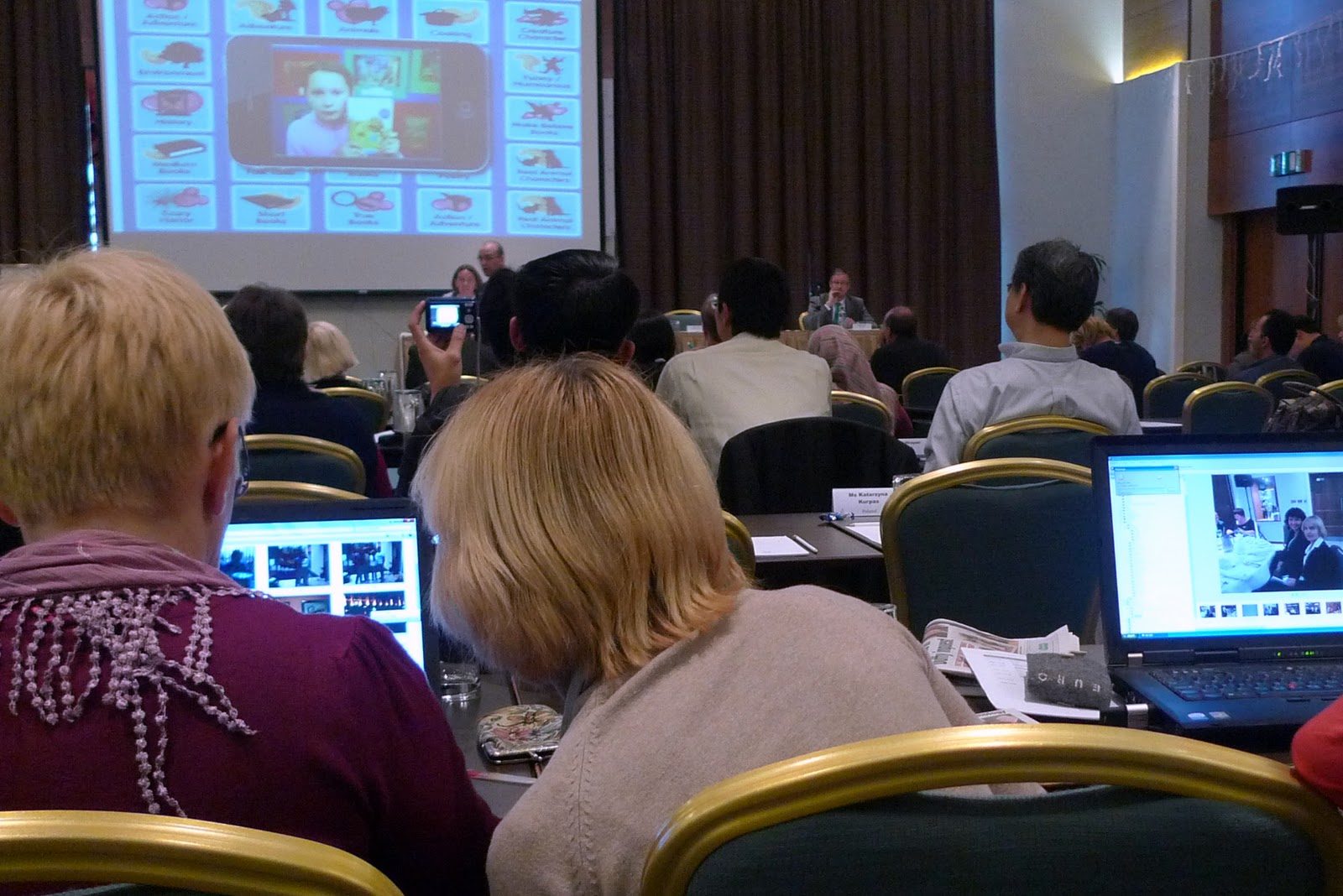
The conference scene has changed a lot, too - screens of different sizes abound amongst the audience

One afternoon we had a dynamic 5-workshop 'speed data' session, with app after app presented at a breath-taking tempo. Tagxedo word clouds, Animoto videos, Geogebra, Audacity, Google apps, Vimeo, Kinect Scratch, blogging services, Etherpad... An endless list of applications and gimmickry was blast onto us, like a firework show. I wonder what the more techonogically novice teachers thought, as even I, with at least some previous exposure and knowledge, found it challenging to follow! I started to think that while it is certainly useful for a teacher to have a digital "toolbox" of various apps, for example, to visualize complicated concepts, in the end, using hundreds and hundreds of these apps all the time is not the key issue. True, this session kept us teachers awake and running, in the after-lunch sleepy hours, and would probably work to do the same for students, but something more solid is needed to shift educational practices.

One of the most interesting presenters for me, was Ms Chan Lai Peng, Deputy Director from the MOE in Singapore. Having organised some student exchanges, and virtual projects with schools in Singapore, I have realized how much our two small nations have in common, despite the striking geographical and cultural differences. Both nations, with small populations, have competed for the top positions in the OECD PISA assessments, for example. Ms Chan explained to us how they have come to the 3rd Master Plan concerning ICT in education. Vigorous programmes have been put into place to deepen the pedagogy of ICT use, and for each school to reach a base line standard in ICT integration. A lot of attention is paid to cyber wellness programmes, with student ambassadors to tutor their peers in every school. What's more, every school has a full-time technical assistant on site - something that we Finnish teachers can only dream of! Ms Chan finished her lively talk in this observation: "Technology is but a tool but it can be a powerful one when put in the hands of skillful teachers." It is our challenge now, as teachers, to keep updating and developing our skills to keep up with the fast pace of change.

Monday, 10 October 2011

A guest blog post by Lindsey Wright: EFL Beyond Blogging

First ever guest post in my blog. Lindsey contacted me, and kindly offered to write about some other online activities for EFL classes, after reading about my blogging experiments. Thank you for these great tips and links!

Lindsey graduated with a degree in Public Health Administration before relocating with her family to Seattle. She is currently writing, and her favorite topics include health care, work-life balance, and travel.

Teachers everywhere are using the Internet, with its wide variety of instantly available information, as a helpful classroom tool. But did you know the Internet is useful for more than research? There are a wide variety of exercises for teachers of English as a foreign language that are available online. One of the most common exercises for teachers who incorporate interactive internet assignments into their curriculum is asking students to write a blog, but there are also other interesting activities out there for students to experience while enhancing their education. Here is a list of just a few engaging activities that you may want to explore with your students.


Webquests

One of the most useful tools on the Internet for teaching EFL students is the webquest. A webquest is a lesson plan that is based on proposing questions that students can research and easily answer on the Internet. These “quests” are perfect for students of all levels as well as students who are just learning English, and cover a wide variety of topics. This is largely due to the fact that webquests are designed to maximize the power of a lesson. They are set up so students spend a lot of time using the information they have found rather than looking for it, and use higher level thinking and build language skills as well.

Generally, students who have basic computer proficiency will be able to handle webquests, even if they are younger or are not very familiar with English. Webquest assignments may need to be adapted if the classroom only has one or very few computers, but can generally work in almost any situation.

Wikis

Another helpful tool for EFL teachers that is being used for online schooling and classroom exercises alike is a wiki. A wiki is a website that is created and edited collaboratively by multiple users. A class can select a topic of interest to them (whether cultural, historical or related to units in other academic classes) and build a website with information about the topic. Additionally, wikis help students learn on an individual level. Each student can be assigned a page that is specifically interesting them that still relates to the overall class topic, and will need to develop research, reading and writing skills in order to actually write their wiki page.

This is a fairly hands-on project for a teacher and requires a familiarity with the Internet and the creation of wikis, but it can be a really powerful tool for a class. Students will be really proud of what they've done when they see their work on the Internet, and the project will develop their language skills in a variety of areas.

Fake Facebook Pages for Historical or Fictional Characters

A final tool that may really engage EFL students is the creation of Facebook pages for historical or fictional characters. This is a really great way to develop research and writing skills while connecting your EFL lessons to other classes. You could assign historical characters from the period of history that your students are studying in their history or social studies classes, or you could assign fictional characters from novels or short stories that are being read in an English class. Alternately, you could simply choose characters that your class has expressed interest in and go from there. The creation of Facebook pages involves research in order to find out biographical information about the characters, as well as photos or artistic depictions of them. It can also develop writing skills as students have to write information about their characters on their pages.

Students will probably be really excited about this project when you announce it to them. You'll have to pay attention, though, as using social networking tools in the classroom makes it all too easy for students to goof off and check their own Facebook pages rather than working on research and writing for the assignment. Also, some school systems may block the use of Facebook on classroom computers, but a variety of offline templates for this project exist. If you can make it work, this will be a great project for your EFL students.

Clearly there a number of ways that allow you to make learning English exciting to your students. However, what is better still is that your options aren't limited to the lesson plans mentioned here. The Internet has opened up a whole world of educational opportunities for teachers and students alike, now all you have to do is explore!

Tuesday, 13 September 2011

Blogging with students 4

One of the most useful aspects of blogging with EFL students is the interaction created through commenting. From previous experience in global collaborative projects, I know how hard it is for many students to get the hang of quality comments. Without careful guidance, they mostly use the colloquial, short social network-style (Facebook etc.) comments, such as 'wow', 'great job' or other similar exclamations, followed by a long line of smilies. To get a little bit more formal and deeper with comments, we discussed this in detail in class, and I also published specific guidelines in the class wiki, modified from the ones I used to use in international projects.


It seemed to work quite well for the first blog posts. I was glad to see clear exchange and development of ideas in the comments of this blog, for example. Some students still mistook commenting to mean the same as the peer feedback we did on the first drafts. My mistake for not keeping these two activities separate more clearly. So they would point out spelling errors, among other things, in their comments, which sounds a little bit funny when the idea was to try and build discussions on the content. I made sure that I left a comment for each student, modelling commenting for them at the same time.

Reflections
  • Hopefully, students will learn the importance of a personal perspective in their blog posts, in order to initiate interesting conversations in the comments.
  • As the blog post assignments still come from me, the whole process seems a little bit false and fake. Nevertheless, I feel we need to start from somewhere, and students do need a guiding hand at the beginning, to find their own blogging voice, and the courage to be creative. Let's wait and see!

Sunday, 11 September 2011

Blogging with students 3

The first student blog posts are now up. After a few, unavoidable (perhaps?), hickups, each student succeeded in publishing their post. Eventually, I am aiming at a more self-directed approach to blogging, and I hope that they will come up with their own post ideas but, to make the beginning easier for them, I opted for the same assignment for everybody - their English learning history. I wanted the first assignment to be non-threatening enough, as 16-year-olds may feel rather self-conscious, and wouldn't probably want to reveal anything too personal about themselves. At the same time, this would give me interesting insights into the ways these students learn English. We talked about the assinment in class, and I published further ideas and instructions in our class blog, together with some examples I found online.

Also, to alleviate the fear of mistakes, which especially some girls suffer from, we followed a process writing routine for the first post. They wrote their first drafts either by hand or printed their typed versions. I then guided them to give positive but constructive peer feedback, and each student assessed one of their classmate's writing. After this, I gave further suggestions, after which the papers were returned to the students. They were then to improve on the first draft, to produce and publish their final version on their blog.

Here is a Wordle cloud of their posts. One important goal of blogging in English will be to widen the students' active vocabulary. Their passive understanding of English far outweighs the vocabulary they actually use when they speak or write English themselves.

Reflections
  • Sticking to deadlines seems to be almost impossible for some teenagers. Should it be a requirement, or should we as teachers be more flexible? Then again, practising commenting afterwards would be difficult if everybody's work is not published first. I also feel that learning the importance of keeping deadlines will serve the students well later on in working life.
  • Students' typing skills seem remarkably lacking. Some didn't even know that you are supposed to leave a space after commas and full stops!
  • Typos were surprisingly common, even after corrections and reminders. Am I being pedantic in expecting almost 100% correct spelling? After all, they are learners of a foreign language. Still, I feel that it reflects negatively on me, as the teacher, if my students publish sloppy work. Should this matter?
  • Text speak - ie. no capital letters, no punctuation, needs to be addressed again and again. I do see a value in teaching them to write slightly more formal language in this type of context. Again, this will serve them well in their later studies.
  • Some students made a lot of effort to improve their first drafts based on the feedback given, while others didn't bother at all. I was hoping that publishing their work for peers to see and read would have resulted in more care and pride in their work, but apparently not for everybody. Maybe I need to work on positive incentives to solve this problem! Or is it that these particular students are not up to online blogging at all? Clearly, they are following the same old, least possible effort tactics of "this will do" that they have learned is enough at school. How to reach students who don't have a lot of inner motivation?
  • Starting student blogging for the first time is exciting but daunting at the same time. I have already had bad conscience about spending quite a bit of class time on guiding the students about some technical problems, the general guidelines of online behaviour, even simple typing advice. As essential as I find learning these skills as early as possible, to be active participants of the digital era, I can't help this nagging feeling whether I should be dedicating more class time on the traditional EFL work. After all, there are the demands of the traditional national final exams looming somewhere in the future! On second thoughts, I hope it will serve us well to take the beginning more slowly, and spend enough time to familiarise the students with the new environment and format. Surely, it will soon start running very smoothly, which will allow us to focus more on the language part. I can already see a lot of potential in blogging as a way to use the language for real communication, instead of having the students doing their writing in isolation, and for the teachers' eyes only.
  • All in all, I think my initial discomfort is down to stepping outside my comfort zone. All through my own schooling, university studies, and most of my working life I have formed a rather fixed idea of what foreign language teaching and learning should be. Suddenly widening that conventional language teacher role, to include some ICT coaching as well, gives me plenty to think about. But it's good to peep over the edges of your safe teaching habits, and try something new!

Thursday, 1 September 2011

Blogging with students 2

Two weeks into the new school year, and we have now managed to create individual blogs for each of the special EXE EFL-course participants. There are 13 Finnish students in the group, two all-year foreign exchange students, and 5 EU Comenius exchange students, who will only stay in our school for 3 months, ie. a total of 21 students at the moment.

I am very grateful for Norwegian colleague, Ann Michaelsen for her expert advice on starting student blogs. I approached her in the summer, and she kindly blogged her tips for everybody to benefit from. Following Ann's advice, I let students choose between Blogger and Wordpress. There are now links to 9 Wordpress blogs, and 12 Blogger ones in the sidebar of our joint assignment blog.


We spent one lesson on talking about writing in public, the history of it, and how today, anybody can get their message published for the whole world to read. Special thanks to Australian educator Tania Sheko for her slideshow! We also talked about online safety, netiquette, copyright and other important related issues to do with starting a blog for school work. I uploaded the main information in our class blog, too, and then sent students home for the weekend, with the assignment of setting up their blogs, and sending me the URL before the next class on Monday. I must say, I felt a little bit uncertain how they would manage but they did just fine! Some minor problems were addressed in class but otherwise, mission accomplished really smoothly. Only two of the students had any experience of blogging beforehand.